Unrecorded Protective-Equipment Time: Build Evidence Before Using an Average
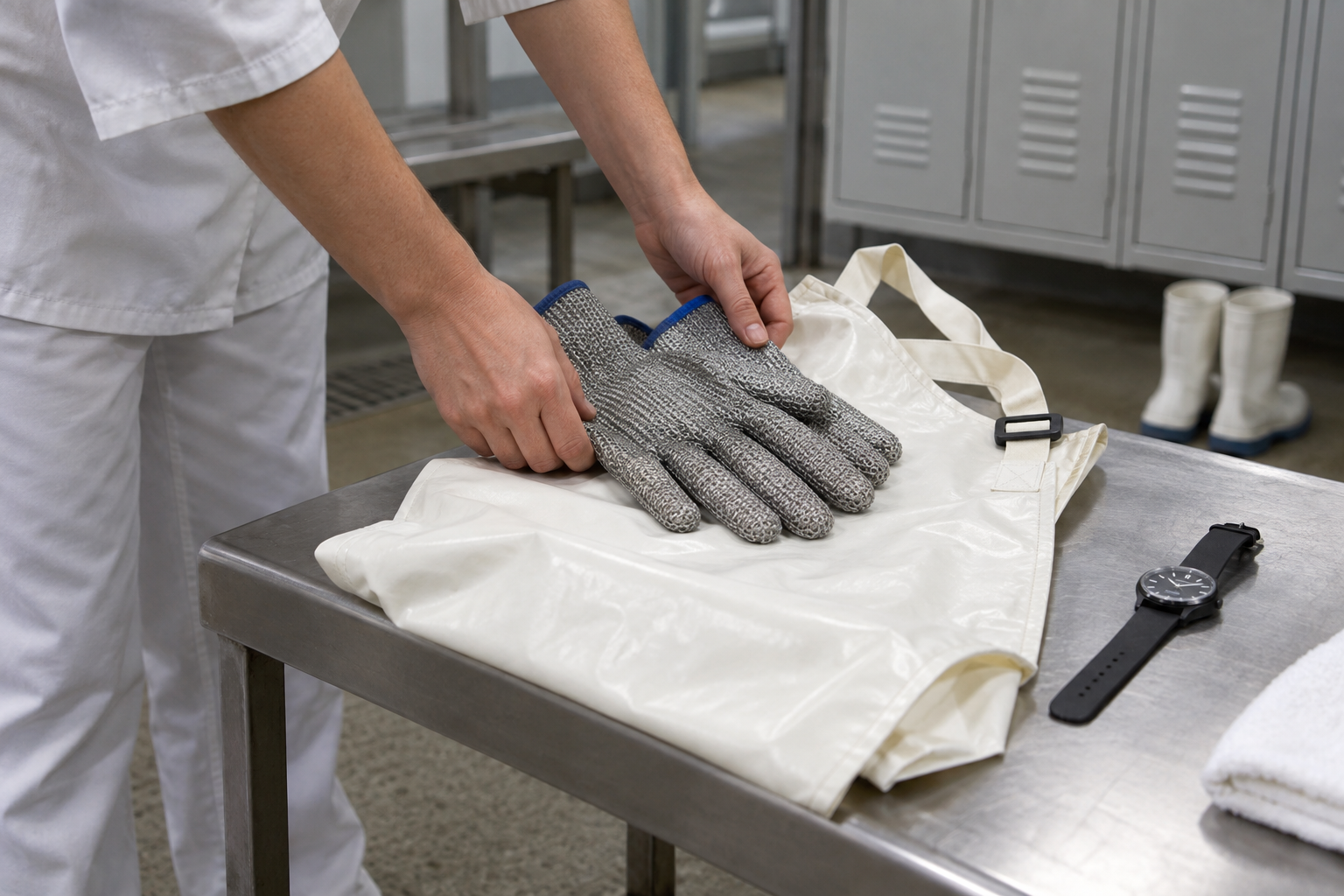
When payroll starts at the production line but required protective equipment must be put on beforehand, a useful wage review begins with the sequence of work. Identify each item, why it is needed, where it is put on, how the employer records the time, and whether any paid allowance already covers it. A single average copied from a coworker or lawsuit can obscure the facts needed to establish your own claim.
Missing employer records do not necessarily make an unpaid-time claim impossible. They also do not remove the need to prove that compensable work occurred and to provide a reasonable basis for its amount. The evidence should address entitlement and measurement separately.
List the equipment and its relationship to the job
Distinguish safety equipment needed for the assigned task from ordinary clothing and personal convenience items. Record employer instructions, sanitation or safety requirements, storage arrangements, and whether the items may be worn home. Different tasks may require different combinations of gloves, guards, aprons, boots, or other gear.
Federal law distinguishes principal work and integral, indispensable activities from certain preliminary or postliminary activities. California wage law requires a separate analysis under the applicable wage order. A collective bargaining agreement can also raise specific federal issues concerning changing clothes under 29 U.S.C. § 203(o). Do not assume that a general description such as “uniform time” resolves every item or every legal theory.
Reconstruct the actual sequence around the clock
Write a chronological account: arrival, collection of equipment, putting it on, inspection, clock-in, travel to the workstation, and any later removal or cleaning steps. Identify the exact location of the timeclock. Distinguish time before the first principal activity from travel or waiting after work has begun; those placements can affect the legal analysis.
Keep the paid-time side of the record as well. Some employers add a fixed allowance, pay certain departments differently, or change policies during the claim period. A calculation that adds every observed minute without subtracting time already paid can overstate the claim. Retain pay codes, policy notices, and time records so counsel can reconcile the two.
Why representative evidence needs a factual foundation
In Tyson Foods, Inc. v. Bouaphakeo, 577 U.S. 442, 454–59 (2016), employees relied on an expert time study because the employer had not recorded donning and doffing time. The Court permitted the evidence in the circumstances of that case, asking whether an individual employee could have used it to prove the employee’s own claim. It did not approve every average or dispense with individual injury.
The Tyson Case Library analysis explains the study, payroll adjustment, and unresolved allocation issue. Its lesson for evidence collection is to preserve similarities and differences: department, task, equipment, shift, physical layout, and the employer’s payment method. Evidence that ignores those differences can be vulnerable even if the employer’s own records are incomplete.
For illustration, suppose one task requires an apron and gloves while another requires additional arm and body protection. A single estimate for both tasks needs a defensible basis. A log identifying what each worker wore and when the task changed is more useful than treating the longest sequence as everyone’s daily time.
Preserve observations without manufacturing precision
Record actual observations close in time and identify estimates as estimates. If a worker remembers a routine but not an exact minute count, preserve the routine and explain the uncertainty. Counsel or a qualified expert can assess whether a study, testimony, or other records support a reasonable inference. A personal log is not automatically an admissible classwide study.
The federal framework discussed in Tyson begins with proof that uncompensated work occurred and sufficient evidence of its amount and extent as a just and reasonable inference when the employer failed to keep required records. The burden then shifts as described in that framework. It is not a rule that an unsupported assertion becomes conclusive because a time entry is absent.
What to do next with a potential unpaid-time claim
- Save equipment rules, job assignments, and changes in required gear.
- Make a sequence chart showing each task and the timeclock location.
- Keep schedules, time entries, pay statements, and any fixed paid allowance.
- Identify which observations concern your own work and which come from others.
- Preserve meaningful differences rather than forcing every shift into one average.
- Ask counsel to separate compensability, measurement, overtime thresholds, and any group-action issues.
For workers in California, both the wage order and federal coverage can matter, and the appropriate claim may not mirror the Iowa litigation in Tyson. The employment practice overview provides context for a wage review; our wage-award review guide addresses a later stage if an administrative award already exists.
Contact Mishra X with the equipment policy and a few representative pay periods. A review grounded in what was required, what happened, and what was already paid is more useful than starting with a demanded average. The objective is an accurate account of compensable time and a sound method of proving it.
Questions readers ask
Does missing timekeeping guarantee payment for my estimate?
No. You still need evidence that uncompensated work occurred and a reasonable basis for the time claimed. Missing records do not make an unsupported number conclusive.
Can everyone use the same equipment-time average?
Only if the evidence and legal framework support it. Tyson did not authorize a universal average regardless of tasks, gear, or working conditions.
Should a paid equipment allowance be included?
Yes. Preserve it so the analysis can account for time already compensated and avoid double counting.
Reconstruct required equipment time and amounts already paid
Mishra X Trial Lawyers can help assess the available procedure using your specific documents. Call (949) 343-9735 or email office@mishrax.com.