V-S-A-: Twelve Other Applicants’ Declarations and an Asylum Grant That Did Not Last
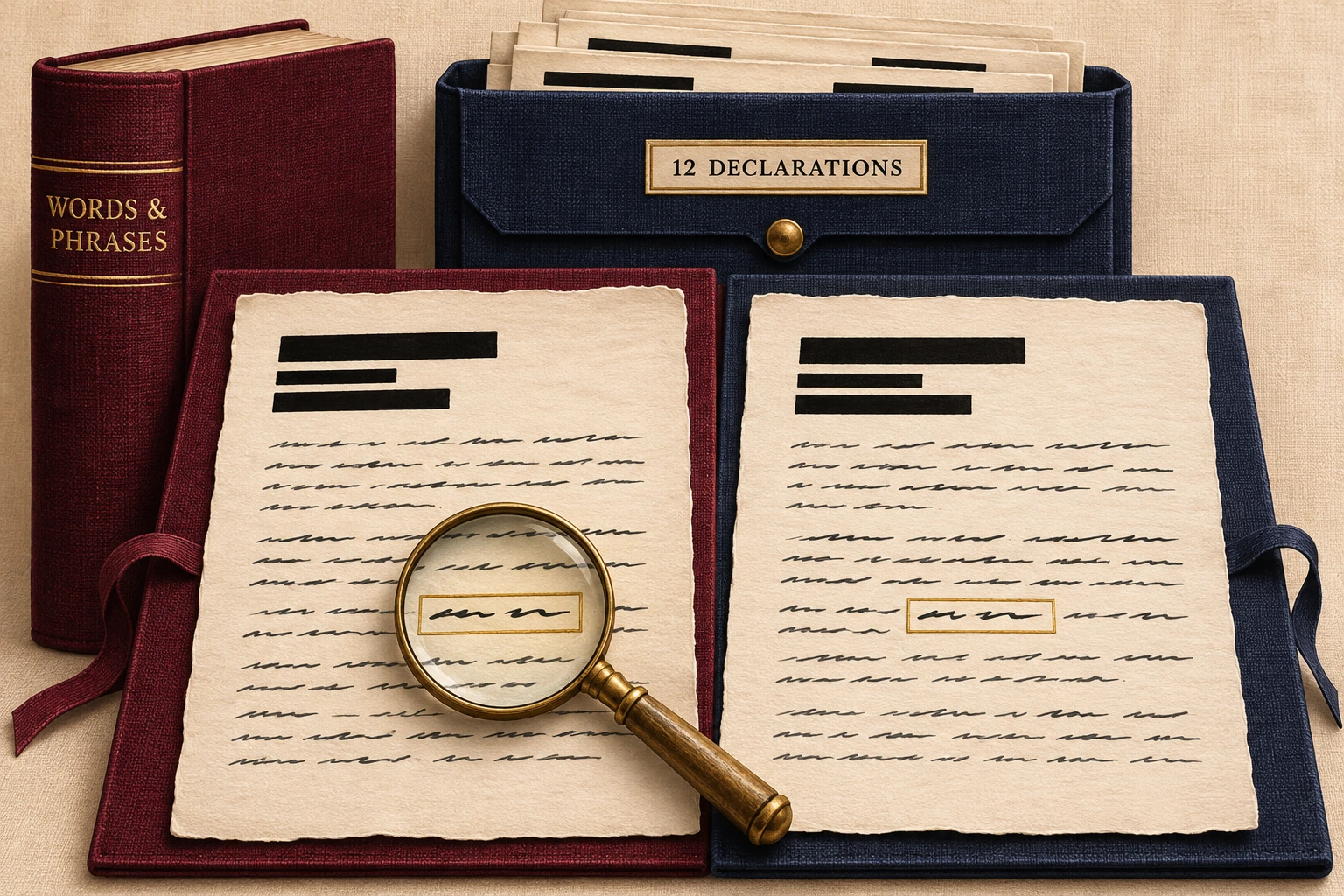
Someone helped you write down what happened to you. A few days before your asylum hearing, the government files statements from a dozen strangers, their names blacked out, and says your story looks like theirs. You have never met these people. You cannot question them. Can the judge use those papers against you?
Yes, the Board of Immigration Appeals said in September 2026, in a case from the Ninth Circuit, the federal appeals region that includes California. An immigration judge had given those papers almost no weight and granted asylum to a man from India. The Board took the grant away and sent the case back.
The case is Matter of V-S-A-, 30 I&N Dec. 37, Interim Decision #4244 (BIA Sept. 10, 2026). It teaches three things. Redacted declarations from other cases can be used, and no one has to produce the people who signed them, though the applicant still gets notice of the claimed similarities and a chance to explain. The comparison looks at how a story is told—shared words, structure and oddly specific details—not at its broad outline. And being believed may not be enough: The Board ruled that this man’s beatings fell short of persecution even if he told the truth.
Twelve declarations arrived two days before the hearing
The man supported the Mann Party, a political party in India. He said members of an opposing party attacked and injured him on two occasions because of it. He filed his declaration on October 2, 2025, six days before his hearing.
On October 6, the Department of Homeland Security filed copies of declarations from 12 other asylum cases, each brought by an Indian applicant on political grounds. DHS said they bore “boilerplate language hallmarks,” shared substantial facts with his declaration and showed that his claim was fabricated. It had blacked out the information identifying each of the 12.
The immigration judge was not persuaded. She did not know how the 12 documents had been created. She worried about the privacy of the other applicants. And the man had no chance to cross-examine any of them. She gave the declarations “little to no weight,” found him credible and granted asylum in a decision dated October 8. DHS appealed.
Why judges compare other applicants’ declarations
The practice comes from Matter of R-K-K-, 26 I&N Dec. 658 (BIA 2015), which involved two brothers from India. One brother’s declaration tracked the other’s. They misspelled several words in exactly the same way. One declaration had spacing gaps suggesting that words from the other had simply been deleted. And the man who said he alone had been arrested wrote “we” and “us,” just as his brother had, whose account also involved his wife.
The Board held that a judge may rely on such similarities in deciding whether to believe an applicant. It also said those findings get “an especially cautious eye,” because matching papers can be innocent. Two applicants may have put true facts into the same template, used the same hired writer, or scrivener, with one unchanging style or shared a translator. One may be the innocent victim of someone else’s copying.
So R-K-K- set three steps, each on the record. The judge gives meaningful notice of the similarities that matter, including copies of the documents. The applicant gets a reasonable opportunity to explain them. Then the judge weighs the totality of the circumstances. V-S-A- keeps that framework and answers two questions the immigration judge had raised about it.
The black bars protected the other applicants
Federal regulations bar disclosure of information in an asylum application without the applicant’s written consent, with limited exceptions, under 8 C.F.R. § 1208.6. The rule exists to keep third parties from identifying an applicant and to prevent retaliation in the home country. The brothers’ case never tested it, because the brother had waived confidentiality.
V-S-A- supplies an answer on privacy. No one had waived anything here, but DHS had redacted the personal details that could link each person to a declaration or an application. That, the Board held, “provides sufficient protection of the declarants’ privacy” and complies with the regulation. It pointed to the Ninth Circuit’s decision upholding a credibility finding built on redacted declarations, Singh v. Bondi, 130 F.4th 1142 (9th Cir. 2025).
The twelve did not have to testify
The immigration judge’s other worry was fairness to the man in front of her: How could he be judged against people he could not question? The Board’s answer depends on why the declarations were in the case.
DHS was not trying to prove that the 12 applicants had been attacked. It did not matter whether anything they wrote was true. The papers came in, the Board said, “solely for the comparative purpose of showing specific similarities in words and phrases.” A witness’s truthfulness is what cross-examination tests, and here the signers’ truthfulness was beside the point. For its conclusion that cross-examination was not required, the Board cited United States v. Johnson, a Ninth Circuit Sixth Amendment case about out-of-court statements offered for purposes other than their truth.
So R-K-K-’s safeguards do not require the declarants to be made available. The Board clarified that decision on this point and concluded that “no due process or privacy violations occurred.” The protection against a mistaken match remains the three steps: notice, a chance to explain and a whole-record decision.
Broad differences do not answer a question about wording
Comparing the declarations, the immigration judge had found the similarities too slight to undermine the man’s credibility. She pointed to three differences. He belonged to the Mann Party, while some declarants belonged to the Indian National Lok Dal Party. He was drawn by the party’s anti-drug message, while some declarants were motivated by caste discrimination or a separate Sikh state. And his village leader supported him, while local authorities did not support some of the others.
Those were the wrong differences, the Board held. Judges should check for word-for-word repetition, repeated similarities in narrative structure and unique, detailed factual matches. That means asking whether there are “identical phrases or words, the same grammatical mistakes and punctuation, the use of distinctive language, or the unnecessary addition of extraneous detail.” She had acknowledged that test and then “clearly erred by focusing instead on the broad facts of the cases.” Two people can belong to different parties and still have sentences that match.
That second list, about identical phrases and shared mistakes, comes from Singh v. Garland, 118 F.4th 1150 (9th Cir. 2024), and that case shows the same rule cutting the other way. An immigration judge disbelieved Jaswinder Singh because his story resembled others in its outline: posters, an approach by a rival party, sticks, police who refused a report. The Ninth Circuit granted his petition. The judge had identified no similarity in language, grammar or narrative structure, and the government conceded that his declaration differed in wording and structure. And that “multiple asylum applicants from the same region of India might describe similar forms of persecution” does not necessarily mean their accounts are false.
Gurparas Singh’s case, decided the following March, shows what this kind of comparison can catch. His declaration and another applicant’s had copy-and-pasted sentences. In most of the declarations, the rescuers were farmers or men working in nearby fields, a detail no one needed to mention. The judge said that “if these claims were fingerprints, they would match,” and the Ninth Circuit upheld both the credibility finding and a finding that he had knowingly filed a frivolous application. Once the copied language was there, the court also counted the shared sequence of events against him.
Read together, as we read them, the three decisions make one point. A similar outline alone does not sink an applicant, and a different outline does not save one. The question is whether the telling itself was shared. On remand, the judge must identify the specific similarities in the declarations before considering the man’s explanations and the evidence as a whole.
Believed or not, the Board said the harm fell short
The Board then went further. The immigration judge had found two incidents: The man was threatened, pushed from a motorcycle and beaten with hockey sticks, then later pushed, beaten and kicked, with treatment for bruises and swelling. DHS argued that he had suffered no significant injuries.
The Board agreed “even if the respondent is viewed as credible.” It described two short assaults, months apart, “requiring only antibiotics and anti-inflammatory medication for minor bruising.” It acknowledged that an applicant need not have seen a doctor at all to show persecution. But here, it wrote, “the fact that the respondent sought medical treatment and only required medication signifies that the harm and injuries were not sufficiently serious.” It compared the detention and physical abuse in Sharma v. Garland, 9 F.4th 1052 (9th Cir. 2021), which did not compel a finding of past persecution.
The threats added little in the Board’s view. The assaults were months apart, and he received no further threats between the second assault and his departure several months later. The Board relied on its own recent rule that a death threat, standing alone, amounts to persecution only if it is credible and the person making it “actually possessed the ability to imminently follow through.” Our E-M-F-S- analysis explains that decision.
The stage of review matters here. The Board decides for itself whether accepted facts amount to persecution, reviewing that question anew, so a grant from an immigration judge offers limited protection if DHS appeals. A federal court asks something much narrower: whether the record compels the opposite answer. Sharma answered that narrower question, and the Board used it on its own review. Urias-Orellana v. Bondi settled that in March 2026. DHS’s argument here cited the original opinion in a Ninth Circuit case that the panel had since amended to apply Urias-Orellana, Singh v. Blanche, 176 F.4th 1139, No. 24-815 (9th Cir. May 15, 2026). The amended opinion reached the same result and quotes a useful test for medical evidence: What matters is “not whether [Singh] went to a hospital, but whether his injuries were severe enough to merit treatment.”
What goes back to the immigration judge
The order vacates the grant of asylum and remands for a new decision. The Board did not find that this man lied. “We express no opinion on the ultimate outcome of these proceedings,” it wrote. The new decision has an order of operations.
- The declarations first. The judge must give them appropriate weight and clearly identify the similarities before turning to the man’s explanations or the reliability of the evidence as a whole.
- Credibility, anew. A fresh finding follows under the three-step framework.
- Future fear, if appropriate. The first judge had applied a presumption of future danger that came with her finding of past persecution. With that finding reversed, the question is whether he meets his burden of showing a well-founded fear. The presumption is the difference: Without past persecution, and with persecutors who are not the government or government-sponsored, the applicant carries the burden on matters such as whether relocating within the country would be reasonable.
- Withholding and torture protection. Because she granted asylum, the first judge never reached these claims. They will be considered for the first time, if appropriate.
What an applicant can still press
The Board relied on Jaswinder Singh’s case, a published Ninth Circuit decision, and faulted the judge for not following its wording test. But it also held that “no due process or privacy violations occurred” when DHS filed these papers, and it called them “admissible and properly redacted.” The Board directed the judge to use those declarations in a new credibility assessment under the three-step framework. An applicant’s response should address the claimed wording matches and explain what is needed to answer them.
There, Singh v. Garland still helps. Where a finding rested only on broad similarities, the court warned, and with names, places and dates removed, Singh “had no way to determine who the declarants were” or explain the overlap. It said the agency’s error “raises due process concerns.” An applicant has a meaningful chance to respond, it said, when the analysis is confined to strikingly similar language and “there is some basis” to assess whether a shared scrivener, translator or template explains it. Make that record at the explanation stage.
The court also questioned how the government had selected its declarations. Without knowing what else it had reviewed, the court said, it was hard to draw conclusions from the sample. But it disclaimed any new duty on the government to disclose its selection method, and Judge N.R. Smith, dissenting, objected to the selection discussion and noted that Singh had raised neither due process nor the government’s methodology. Treat selection as an argument to make, not a requirement to invoke.
In R-K-K-, the brother’s confidentiality waiver let the applicant use the complete declaration—including information about the transcriber—to explain the similarities. The Board described that access when explaining the applicant’s opportunity to respond. In V-S-A-, it approved the redacted evidence and ruled cross-examination unnecessary, while directing the judge to apply the three-step framework on remand. If a redaction prevents a useful explanation, identify the missing information and explain why it matters—for example, whether the accounts shared a translator or preparer.
The wording test has critics of its own. All three judges on the panel in Gurparas Singh’s case, in a concurrence, said Singh v. Garland was wrong to insist on identical language and that the Board could clarify R-K-K- to override it. In V-S-A-, the Board used its clarification for cross-examination and applied the Singh v. Garland wording list.
If DHS files other people’s declarations in your case
- Get the comparison on the record. R-K-K- calls for copies and an explanation of how the similarities undermine credibility. Ask the judge to identify the specific words or passages at issue.
- Ask for time. A late filing can leave little room to respond. The judge in the brothers’ case gave about three months to find the person who prepared the application. The judge in Gurparas Singh’s case paused for nearly three weeks.
- Trace how your declaration was made. Who wrote it, in what language, from what notes, and who translated it? In the brothers’ case, the transcriber never testified and the two men’s accounts of his work conflicted. If a preparer, translator or template explains the match, that person’s statement or other proof may matter more than your own denial.
- Compare line by line. Mark identical sentences, shared errors and details no one needed to include. Then mark what is yours alone. Differences in party or motive may not answer shared wording or structure.
- Take the frivolousness warning seriously. A judge warned Gurparas Singh that someone who knowingly files a frivolous application “could be forever prevented from ever receiving any benefits under immigration laws.” The finding is separate from credibility and requires its own safeguards and specific findings. Gurparas Singh received that finding. Our S-M-H- analysis explains the written warning.
- Document the harm itself. Medical records should show what the injuries were and why treatment was needed. Under V-S-A-, treatment with medication alone may be read as a sign the injuries were minor, so the full picture of the injury and its effects matters.
- Matter of V-S-A-, 30 I&N Dec. 37, Interim Decision #4244 (BIA Sept. 10, 2026)
- Matter of R-K-K-, 26 I&N Dec. 658, Interim Decision #3848 (BIA 2015)
- Singh v. Garland, 118 F.4th 1150, No. 23-95 (9th Cir. 2024)
- Singh v. Bondi, 130 F.4th 1142, No. 23-1247 (9th Cir. 2025)
- Singh v. Blanche, 176 F.4th 1139, No. 24-815 (9th Cir. May 15, 2026), amended opinion; petition for rehearing en banc filed June 29, 2026
- Matter of E-M-F-S-, 29 I&N Dec. 379 (BIA 2026)
- Sharma v. Garland, 9 F.4th 1052 (9th Cir. 2021)
- Urias-Orellana v. Bondi, 607 U.S. 537 (2026)
- 8 C.F.R. § 1208.6
Have the declarations compared before you respond
If DHS has filed other applicants’ declarations in your case, or the Board has reversed a grant of asylum, bring your declaration, the government’s filing, the notice of the similarities and your medical records. We can compare the wording and review what response may be available. For more on our work, see our deportation defense practice. Call (949) 343-9735 or email office@mishrax.com.