Urias-Orellana: What a Court Reviews After an Asylum Denial
If an immigration judge believes your account but denies asylum, the written decision can be difficult to reconcile with what you endured. An appeal then raises a practical question: How much can a federal court reconsider the agency’s answer?
The family in Urias-Orellana v. Bondi, 607 U.S. 537 (2026), wanted the appeals court to decide for itself whether the accepted facts amounted to persecution. The Supreme Court ruled that the court must use substantial-evidence review. Under that deferential standard, the record must compel a different conclusion to overturn the agency’s application of the persecution standard to those facts. Justice Jackson wrote the unanimous March 4, 2026 decision affirming the First Circuit’s judgment.
The family described threats and repeated moves
Douglas Humberto Urias-Orellana, his wife and their child entered the United States in 2021. They appeared in immigration court in Boston, conceded that they were removable and sought asylum as a defense to removal. Urias-Orellana was the only witness at the hearing.
He testified that a hitman from his hometown in El Salvador had targeted him since 2016. The man had shot two of his half-brothers and threatened to kill every member of the family. Urias-Orellana described several moves within El Salvador. After the moves, men demanded money and threatened to leave him like his brothers. One man assaulted him when he briefly returned to his hometown.
According to the Court’s account of that testimony, the family’s final move came in 2021. Urias-Orellana then learned that men were asking about newcomers in the town. The family left for the United States. Those details supplied the experiences the immigration judge had to evaluate under asylum law.
The judge accepted the account but denied asylum
Asylum eligibility required the family to establish refugee status. 8 U.S.C. section 1101(a)(42)(A) connects that status to persecution or a well-founded fear of persecution because of race, religion, nationality, membership in a particular social group or political opinion. Section 1158(b)(1)(A) authorizes the government to grant asylum to a person it determines is a refugee.
The immigration judge found Urias-Orellana credible. The judge nevertheless concluded that the account and supporting evidence fell short of establishing past persecution or a well-founded fear of future persecution. Credibility and the legal significance of the accepted experiences were separate parts of the decision.
For the death threats, the judge applied a First Circuit standard requiring threats sufficiently menacing to cause significant actual suffering or harm. The judge pointed to the absence of medical, psychiatric or psychological evaluations showing that impact. For future danger, the judge assessed the family’s relocations as successful escapes and found that danger resurfaced when Urias-Orellana returned to his hometown or nearby areas. The opinion recounts those particular reasons as the judge’s assessment of this record.
The Board of Immigration Appeals affirmed. It agreed with the judge’s assessment of the harm as a whole and the significance of relocation. The wife’s and child’s asylum claims depended on Urias-Orellana’s claim, so all three received removal orders. The First Circuit then upheld the agency’s decision under substantial-evidence review.
Substantial evidence applies to the whole persecution determination
The dispute reached the Supreme Court because courts of appeals had used different approaches. Some deferred to the agency on both the underlying facts and whether those facts met the persecution standard. Others separated the two, deferring on facts while reviewing the application of law anew.
The family urged the second approach. They argued that deciding whether accepted facts amount to persecution mixes law and fact. In their view, the statute’s requirement to defer to factual findings left the appeals court free to make that mixed determination for itself.
The Supreme Court read 8 U.S.C. section 1252(b)(4)(B) to require deference across the persecution determination. Its explanation of the governing standard covers both what happened to the applicant and the agency’s application of asylum law to those findings. The court reviewing that determination asks whether the record compels a contrary conclusion.
That makes the agency’s actual reasoning important. An applicant challenging the application of the persecution standard needs to connect the record to the conclusion the agency reached. The reviewing court gives weight to an agency answer that a reasonable decision-maker could reach from the evidence. The possibility of a more favorable reading alone leaves that answer in place.
Why the Court looked back to Elias-Zacarias
The Court grounded its reading in INS v. Elias-Zacarias, 502 U.S. 478 (1992). As Urias-Orellana recounts that earlier decision, an asylum applicant feared retaliation after refusing guerrilla recruitment in Guatemala. The Supreme Court had required evidence compelling the necessary finding to reverse the agency’s persecution determination.
The important point was the reach of that review. In the Court’s account, Elias-Zacarias applied deference to the agency’s overall conclusion about asylum eligibility, including its application of the statutory standard to the testimony. The Court read the present statute as carrying that approach forward. It therefore applied substantial-evidence review to the complete persecution determination in this family’s case.
Hearing a question and reviewing its answer are different
The family also relied on decisions allowing courts to review certain mixed questions of law and fact. Those decisions concerned a court’s authority to consider a question despite statutory restrictions on judicial review. The Court treated that as a separate inquiry from the standard the court uses once review is available.
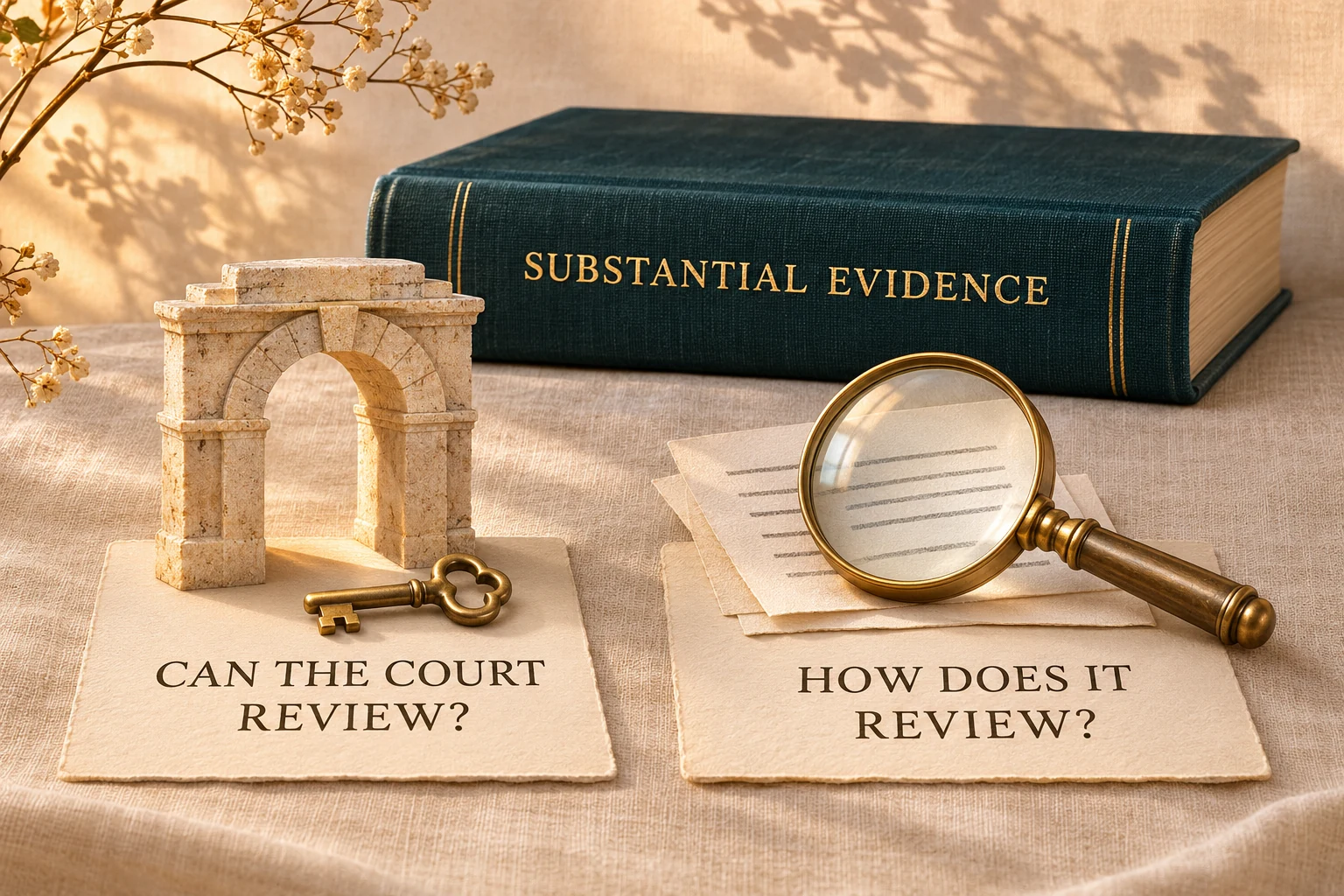
In its discussion of Wilkinson v. Garland and Guerrero-Lasprilla v. Barr, the Court explained the two statutory jobs. Section 1252(a) addresses the availability of judicial review. Section 1252(b) supplies standards for reviewing removal orders. Treating an issue as a reviewable question of law under one provision therefore leaves the separate review-standard question to be answered under the other.
For someone reading an asylum appeal, the distinction helps identify the next task. Establishing that the court can hear an argument opens the door to review. Counsel must also explain how the argument should be reviewed and why the existing record warrants relief under that standard.
The question the family presented defined the ruling
The family had accepted the persecution standard used in the First Circuit and argued that the undisputed facts satisfied it. The Supreme Court therefore decided how an appeals court reviews the agency’s application of that standard to the facts. Its first footnote explains that framing and records the Solicitor General’s agreement that purely legal questions about the appropriate persecution standard receive review anew.
This gives counsel a concrete reason to read the agency decision closely. A disagreement about the governing legal definition calls for identifying the definition the agency used and explaining the claimed legal error. A challenge to the application of an accepted standard calls for showing what the record establishes under the applicable review rule. The family’s Supreme Court case concerned that second question.
The judgment was affirmed, and the Ninth Circuit applied the rule
The Supreme Court affirmed the First Circuit’s judgment because it had used the correct standard of review. That was the unanimous result of the March 4 decision.
The Ninth Circuit later applied Urias-Orellana in its amended May 15, 2026 opinion in Singh v. Blanche, No. 24-815. It reviewed the agency’s persecution determination for substantial evidence and explained the effect of the Supreme Court’s decision on its earlier review rule. It ultimately denied the petition. That application makes the review-standard distinction relevant to asylum cases reaching the federal appeals court that covers California.
What to bring to a review of an asylum denial
Start with the immigration judge’s decision and the Board’s decision, together with the hearing transcript and evidence already submitted. Identify each reason for the denial: What the judge believed, how the judge evaluated the harm, and what the decisions said about future danger or relocation. Section 1252(b)(4)(A) directs the appeals court to decide the petition on the administrative record underlying the removal order, so locating the relevant evidence in that record matters.
If the denial turns on credibility, our analysis of Alam and review of the whole credibility assessment addresses that separate problem. If the immediate task is understanding evidence of threatened harm, our guide to death threats and persecution evidence explains the proof questions. Urias-Orellana addresses the reviewing court’s role once the agency has applied the persecution standard to the facts.
Sources
The Supreme Court’s official preliminary print of Urias-Orellana supplies the facts, arguments, reasoning and judgment discussed here. References to earlier Supreme Court cases explain that opinion’s analysis. The linked federal statutes provide their current text, and the Ninth Circuit’s official amended Singh opinion supplies the later application.
Have the asylum decision and appeal record reviewed together
Mishra X Trial Lawyers can review the reasons for an asylum denial, the evidence already in the record and the legal question an appeal would present. Bring the immigration judge’s and Board’s decisions, hearing records and any court notice you have received. Call (949) 343-9735 or email office@mishrax.com.