Robledo-Ramirez: A Seven-Day Bond-Hearing Order After an ICE Roadside Arrest
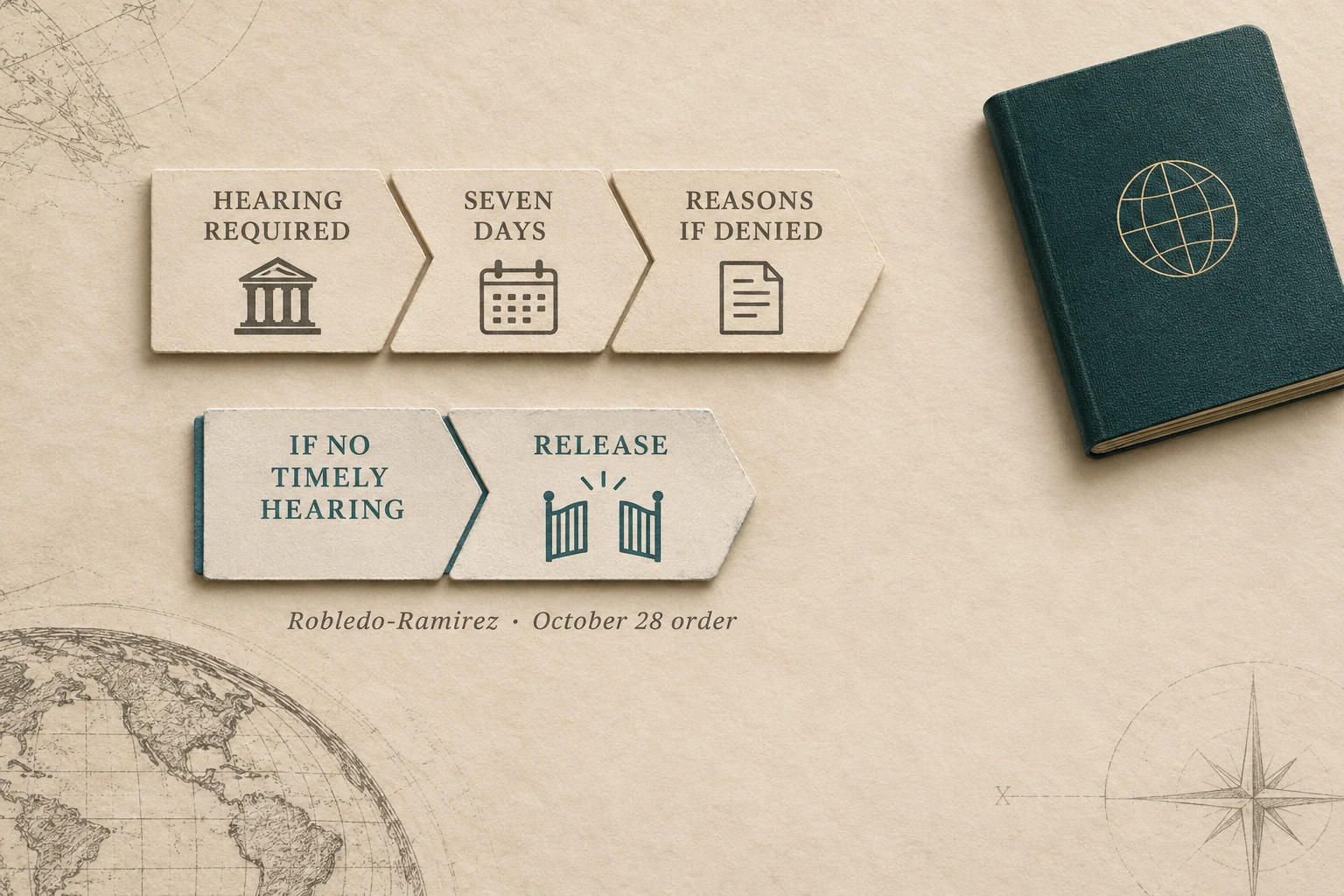
When someone is stopped on the way to work and taken into immigration custody, a family needs to know how soon a judge can hear the request to come home. In Robledo-Ramirez v. Semaia, No. 5:26-cv-06068-JDE (C.D. Cal. Oct. 28, 2026), ECF 10, a federal judge required an individualized bond hearing within seven days. If the government failed to provide that hearing on time, the order required release under narrowly tailored conditions, if any.
The result turned on the process available to this man and the timetable the court imposed. Magistrate Judge John D. Early concluded that a prompt hearing after detention adequately protected the liberty interest he assumed for purposes of the analysis. He also required a written explanation, including factual findings, if the immigration judge denied bond. Understanding those reasons helps a family and counsel identify the custody decision that needs attention.
The roadside stop brought two different accounts before the court
The order describes Robledo-Ramirez as a Mexican citizen who entered the United States without inspection in 2003. He told the court that he had lived outside immigration custody for more than 23 years while working to provide for his children. On October 8, 2026, ICE officers pulled him over on his way to work and arrested him.
He alleged that the officers lacked a warrant, probable cause and a hearing before taking him into custody. The order also recounted the government’s Form I-213, an immigration enforcement record. According to that account, officers looking for someone in Oxnard saw a pickup driver who fit the person’s physical description, stopped the truck and conducted a field interview. The form said a supervisor approved the arrest and an administrative warrant was served when it was safe to do so. These are the parties’ accounts as the order describes them.
The order’s account of the custody record also lists driving convictions: a 2006 alcohol-or-drug DUI, driving without a license in 2008, and driving with a suspended license in 2012 and 2016. It records that ICE served a custody determination and a Notice to Appear on the day of the arrest. The court later relied on that same-day notice when assessing the available process.
The habeas request focused the court on continuing custody
Robledo-Ramirez filed his federal habeas petition on October 14, seeking immediate release among other relief. The government answered on October 22 that he was properly detained but could request a bond hearing under 8 U.S.C. section 1226(a). He replied that day.
For the challenge based on the arrest, the judge examined whether continued detention justified release through habeas. The order explained that habeas tests the legal basis for present custody. It applied the distinction between seeking release from custody and seeking damages for an unlawful arrest, then rejected immediate release based on the alleged arrest defects on this record. That reasoning directs attention to both the arrest history and the legal basis for keeping someone detained.
Why the judge found a prompt bond hearing sufficient
The due-process discussion applied the three-part framework from Mathews v. Eldridge, 424 U.S. 319, 335 (1976), to assess the claimed loss of freedom. The test weighs the person’s private interest; the risk of an erroneous deprivation of that interest—wrongly taking it away—and the probable value of additional safeguards; and the government’s interest, including the function involved and the fiscal and administrative burdens that added procedures would create. Here, the judge assessed those considerations through the same-day notice and the prompt bond hearing he required.
His long life outside custody and support for his children supplied the personal stakes. The judge assumed that a protected liberty interest existed when he was detained. He then considered the safeguards and the government’s interests, rather than resolving that threshold question conclusively.
Several facts mattered to the judge’s analysis. This was Robledo-Ramirez’s first immigration detention. He asserted no earlier parole or other formal conditional release from immigration custody. He had received written notice of the basis for removal proceedings on the day he was detained. And, under the federal order, he would receive a bond hearing by November 4, less than a month after the arrest.
At that hearing, he could have counsel, present evidence and arguments for release, and appeal an adverse decision to the Board of Immigration Appeals. In Robledo-Ramirez, the court treated those procedures as reducing the risk of an erroneous deprivation of liberty. It also recognized the government’s interest in enforcing immigration law. Weighing those considerations, the judge concluded that a prompt hearing after detention would sufficiently protect the asserted liberty interest on this record.
The timing was part of that reasoning. The court coupled its assessment of adequate process with an enforceable deadline for the hearing. For counsel evaluating the result, the promised hearing and the terms of the federal order belong beside the arrest documents in the custody chronology.
Why the court excused another administrative request
The government argued that Robledo-Ramirez first needed to request a bond hearing through the immigration process. The judge rejected that exhaustion argument in this instance because the government already conceded the hearing was available upon request. Requiring another procedural step would, in the judge’s view, unnecessarily delay that available remedy.
That explanation was tied to the hearing the government acknowledged he could receive. It concerned obtaining an initial hearing. A case with an existing bond denial presents a different procedural history: Our analysis of Balasanyan explains why that court required review of the later custody ruling. The practical starting point is to identify whether a person is awaiting a hearing, challenging a completed hearing, or seeking enforcement of a federal order.
The order required a hearing on time or release
The operative directions in the October 28 order were specific. The government had to provide Robledo-Ramirez an individualized hearing before an immigration judge under section 1226(a) within seven days. If bond was denied, the immigration judge had to issue a written, reasoned decision containing the supporting factual findings.
If that hearing was not timely provided, the government had to release him. Any conditions had to be narrowly tailored and no more restrictive than necessary to reasonably assure his appearance and protect the community. The words “if any” matter: The order permitted appropriate conditions; it did not require conditions in every event. The court granted the petition in part and denied all other requests for relief with prejudice. Its separately entered October 28 judgment repeated those directions.
This analysis describes the October 28 order. Whether the government later provided the hearing, whether bond was granted or denied, and whether Robledo-Ramirez was released must be established from the later proceedings and custody record.
The next records should show what happened under the order
For a family with a similar court order, the most useful follow-up documents are the hearing notice, the actual bond decision and any record confirming release or continued custody. Match those documents to the federal order’s date and requirements. A hearing notice identifies a scheduled event; the hearing decision establishes what the immigration judge actually decided.
Give counsel the custody determination, Notice to Appear, petition, government response and federal order together. Include any earlier release or supervision documents because they describe the person’s custody history. Counsel can then assess the current legal basis for detention, the procedure already provided, and the precise relief that remains appropriate. Share sensitive records through the private process arranged with counsel.
Have the custody order and hearing record reviewed
Mishra X Trial Lawyers can review immigration detention records, bond proceedings and federal habeas options. If your family has a hearing deadline or a bond denial, bring the written orders and the latest custody documents so counsel can assess the next step. Call (949) 343-9735 or email office@mishrax.com.