Danzey: The Contract Said California. The Work Was in Florida.
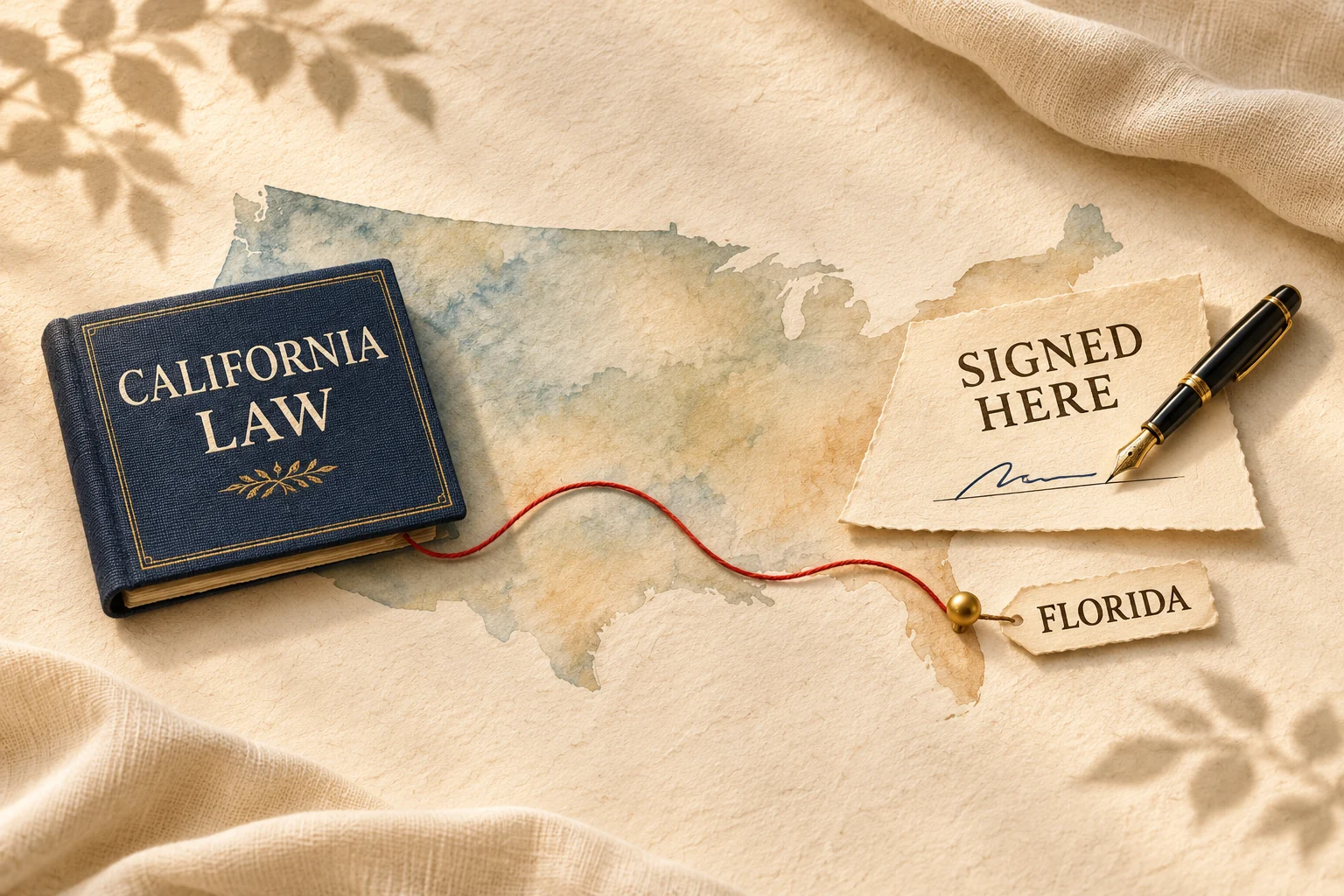
Your contract says California law governs. Your paychecks carry a California address. Your supervisor works in California. You work from home in another state and have never done a day’s work in California. Then the job hurts you. Can you bring your claim to California’s workers’ compensation system?
Jessica Danzey tried. A workers’ compensation judge ruled that California had no power to hear her claim. The Workers’ Compensation Appeals Board agreed. Neither ever decided whether she had been injured at all.
The case is Danzey v. Aravo Solutions, Inc., No. ADJ19483679 (WCAB May 15, 2026). Three points run through the decision. A supervisor in California and a remote arrangement do not create jurisdiction. A contract cannot give the Board power that only the Legislature can give. And the place you were standing when you said yes to the job can decide the whole case.
A Florida job with California fingerprints
Danzey was a proposal specialist at Aravo Solutions, Inc. She always lived in Florida and worked from there, and the position was fully remote. In July 2024 she filed a claim for a cumulative injury, one that builds up over time, to multiple body parts between January 30, 2022 and March 5, 2024. The claim involved allegations of verbal abuse and harassment. Her application placed the injury at a San Francisco address.
California showed up all over her job. Her January 2022 employment contract said: “This Agreement will be governed by the laws of the State of California.” Aravo is incorporated in California and headquartered in San Francisco. Her paychecks had a California address. Her direct supervisor, Britt Guenther, was based in California.
Texas showed up too. Aravo’s chief financial officer testified that the primary business is conducted in Texas, where most meetings happen, and that human resources and payroll are there. David Silva, the head of human resources during her employment, called Texas the company’s “nerve center.” Danzey’s email signature listed an address in Irving, Texas. She was not required to keep Pacific time. Witnesses disagreed about who hired her and who first supervised her: She testified that California-based Daniel Gibson made the offer and that she first reported to him, while defense witnesses said the hiring authority and her first supervisor were in Texas.
The only question at trial
The parties tried one issue: statutory subject matter jurisdiction, meaning the legal power to decide this kind of claim at all. They agreed on the facts that mattered most. Danzey signed her contract in Florida. She lives in Florida. She never physically worked in California.
In February 2026 the judge found that she was hired in Florida, worked in Florida and sustained her alleged injuries there. California, he ruled, had no jurisdiction.
Danzey asked the Board to reconsider. It explained that a claim must clear two separate hurdles. The injury needs a significant connection to California, which is a matter of due process. And a statute must give the Board power over the claim. The Board is “solely a creation of the Legislature,” so without a statute conferring jurisdiction, it wrote, “we cannot exercise jurisdiction over the claim.”
Three provisions supplied the possible answers. Labor Code section 5300 is the general grant for injuries in California. Section 3600.5(a) reaches an injury outside California when the employee “has been hired or is regularly working in the state.” Section 5305 reaches out-of-state injuries where the employee “is a resident of this state at the time of the injury and the contract of hire was made in this state.” The Board noted that the residency requirement has long been recognized as unconstitutional. For Danzey, that left three plain questions. Was she injured in California? Was she hired in California? Did she regularly work in California?
A contract clause could not open the door
The governing-law clause drew considerable attention in the case. The judge had noted that it referred to California’s laws without referring to workers’ compensation law. The Board did not need that distinction. “[P]arties cannot create subject matter jurisdiction via contract where it does not otherwise exist,” it wrote. Even a clause clearly sending workers’ compensation disputes to California could not do it without “an independent, statutory basis.”
The logic is simple. A clause is an agreement between two parties. The Board’s power comes from the Legislature, and two parties cannot hand it more.
Aravo’s conduct did not open it either
Danzey also argued that Aravo had given up the objection. The Board rejected each version.
She said Aravo raised jurisdiction too late. Subject matter jurisdiction cannot be waived, the Board answered, and Aravo’s answer had raised “lack of jurisdiction” in August 2024 anyway.
She said Aravo admitted jurisdiction by asking to move the case to San Francisco. But that request rested on her own application, which placed the injury there. Repeating what she alleged admitted nothing.
She said Aravo should be stopped from contesting jurisdiction here because it had not contested jurisdiction in a civil case in Superior Court. The Board was blunt: “The Superior Court is not the WCAB, and a civil claim is not a workers’ compensation claim.”
Where a long-distance injury happens
Danzey’s most inventive argument concerned the location of the injury itself. Because the alleged abuse and harassment came from people based in California, she argued, the injury should count as happening in California, even though she was in Florida when it reached her.
The Board called the argument “undeniably creative.” She cited no authority for it. And the Board offered a picture: “If someone in California is injured by a firework discharged from across state lines in Nevada, we do not think there would be any credible argument that the individual was injured in Nevada rather than in California.” An injury happens where the person is hurt. Danzey’s alleged injury occurred in Florida.
The argument had a factual problem too. According to Silva, the employee Danzey principally accused was based in Texas, not California.
A supervisor in California and a remote arrangement did not change the answer. “Although the Legislature could choose to provide for the exercise of subject matter jurisdiction in such circumstances, it has not done so,” the Board wrote. That sentence tells remote workers where the line sat when the Board ruled, and who could move it.
What counted was where she said yes
The Board then turned to the two out-of-state routes. Regular employment in California was never a real contest. Danzey never worked here, and the Board did not understand her to argue otherwise.
That left the hire. Under appellate decisions the Board treated as binding, Bowen v. Workers’ Compensation Appeals Board and Tripplett v. Workers’ Compensation Appeals Board, the place of hire is where the person offered the job accepts it. Danzey accepted by signing the contract in Florida. That fact was stipulated, and she confirmed it at trial.
This is why the fight over who made the offer led nowhere. It might seem to matter that a California-based manager interviewed her or that the offer may have come through him. The rule looks to the other end of the transaction. It asks where the worker was when she accepted.
The one opening the Board left
The Board raised one more possibility on its own. In Atlanta Falcons v. Workers’ Compensation Appeals Board, a 2025 appellate decision the Board calls Gandy, the Court of Appeal suggested that a professional athlete employed by a California-based team could be treated as hired in California based on the team’s identity alone, even if the athlete accepted the offer elsewhere. Neither side had raised it.
The Board assumed for argument’s sake that the idea might reach beyond athletes. It still did not help her, because the evidence did not show that Aravo was California-based in the way a California team is. The testimony was “inconclusive at best”: incorporated and headquartered in California, but with its primary place of business and “nerve center” in Texas, most executives there, physical offices in Texas and Oregon, and a founder in Spain.
The Board left that question for another case. “Whatever arguable application” Atlanta Falcons might have to “a non-athlete case involving an employer that is clearly and unambiguously based in California,” it wrote, “this does not appear to be that case.” So a remote worker at a company whose people and operations really are in California may have an argument Danzey did not. The decision does not say that argument wins.
What the decision ended
The Board concluded that Danzey “was hired in Florida, regularly employed in Florida, and that the alleged injuries occurred in Florida,” and it denied reconsideration on May 15, 2026. The February finding stands. Nearly two years after she filed, California’s workers’ compensation system had decided only that it could not decide.
Whether the job injured her, how badly and what she might be owed were never tried. The decision mentions a separate civil case in Superior Court but says nothing about its outcome, and it does not address whether Florida’s system could take her claim. That is a question for Florida’s rules. A “no” from California is a reason to look at another state’s deadlines early, because they may keep running while California litigates.
What to check if you work across a state line
- Where you accepted the job. Find the offer, the signature page or electronic-signature record, and any message saying yes. Note where you physically were. In Danzey, that location settled the hire question.
- Whether you ever regularly worked in California. Collect schedules, travel records and assignments that show how often you actually worked here. Danzey never did, so her case says little about someone who has.
- Where you were when you were hurt. An injury that occurs in California falls under the general grant in section 5300. Pin down the place of each event, or the places you worked during a cumulative injury.
- Where your employer actually operates. Look past the state of incorporation. In weighing Atlanta Falcons, the Board looked at the primary place of business, where executives work, where the offices are and where the meetings occur.
- What your contract says, without leaning on it. Keep the exact wording. Danzey holds that the words alone cannot supply jurisdiction.
- Your other deadlines. If California may be unavailable, ask promptly about the workers’ compensation system where you work and any other claim you may have.
Other kinds of claims ask different location questions. For employment-law claims, see our guide to remote-worker location records. For representation in a California claim, see our California workers’ compensation practice.
Find out whether California can hear your claim
If you work remotely or across state lines and California is part of the picture, bring your offer and acceptance, your contract, records of where you worked, and your injury report. We can review whether there is a California basis for the claim. If California is not available, you may need a lawyer licensed in the state where you work. Call (949) 343-9735 or email office@mishrax.com.