Garcia Martinez: A Private Lawyer, a Fee Waiver Form Full of Zeros and a Motion the Board Would Not Accept
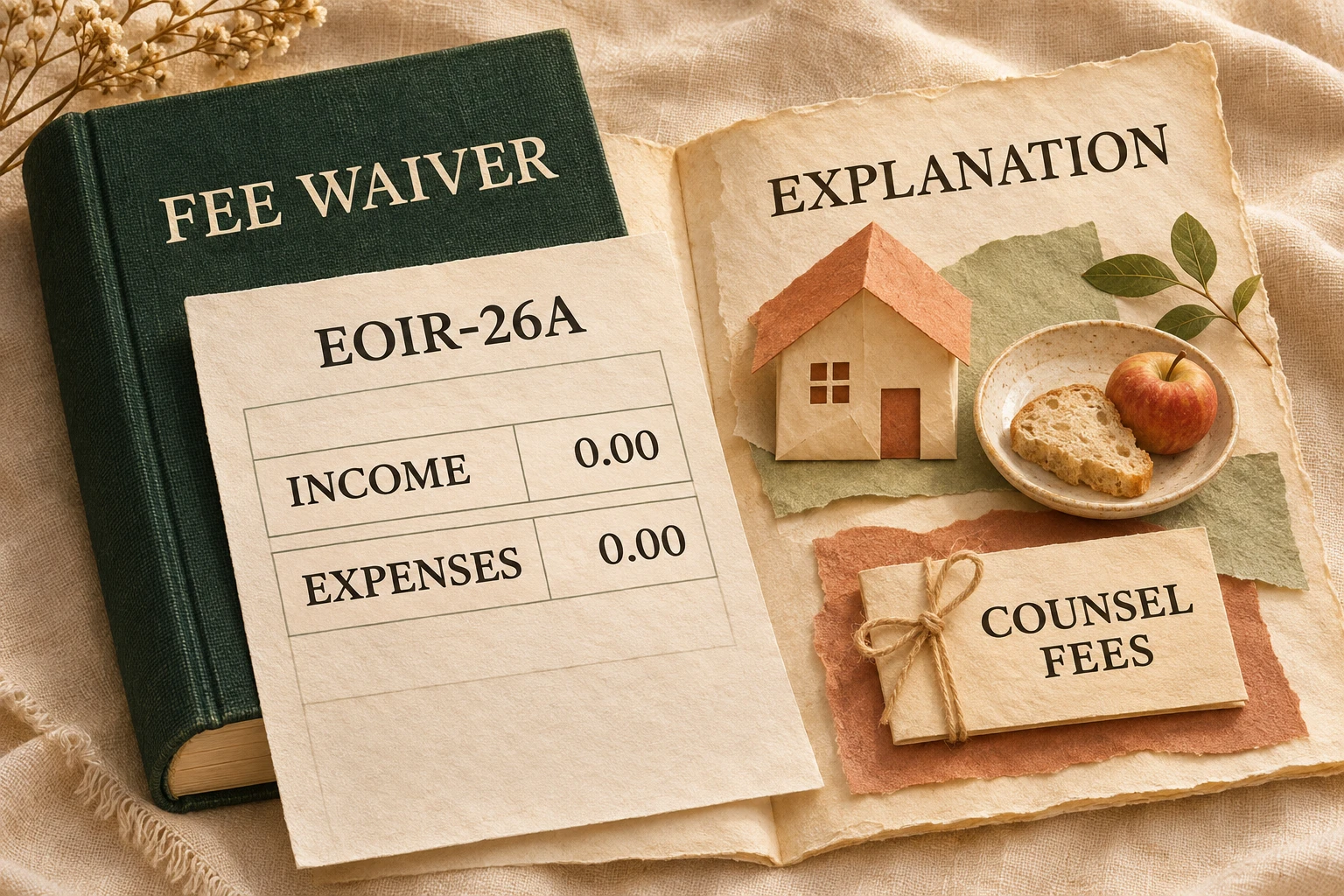
Luis Angel Garcia Martinez asked the Board of Immigration Appeals to excuse the filing fee on his motion. On the required form, he listed zero income from every source. He also listed zero expenses: nothing for housing, utilities, living expenses, debts, medical costs, taxes or attorney fees. He signed under penalty of perjury. He had been in the United States for more than 24 years, was seeking relief based partly on the support he gave his citizen wife and two citizen children, and had kept a private lawyer since 2018.
Anyone asking an immigration judge or the Board to waive a fee now faces his question: What must the form show when the person has a lawyer, or reports no money at all? The amount at stake has grown. By the date of this article, a motion to the Board cost $1,030.
The Board answered in Matter of Luis Angel Garcia Martinez, 29 I&N Dec. 169, Interim Decision #4114 (BIA Aug. 8, 2025), a published precedent by a three-member panel, written by Appellate Immigration Judge Baird. It created two presumptions, meaning starting assumptions that stand unless the person shows otherwise. A person who is not detained and has private counsel is presumed able to pay the filing fee. And a request from a non-detained adult with zeros in every income block is presumptively invalid. The Board denied the waiver, rejected the motion as improperly filed and gave him 15 days to refile with the fee or a new waiver request.
Twenty-four years here, a lawyer since 2018 and zeros on the form
The removal case began on February 26, 2018, when the government served a Notice to Appear, the charging document in immigration court. It charged him under the provision covering people present without having been admitted or paroled. He hired a private attorney in October 2018 and applied for cancellation of removal, relief that lets certain long-term residents stay if they meet strict requirements, including hardship to close family who are citizens or permanent residents.
An immigration judge denied the application and ordered him removed to Mexico. The Board dismissed his timely appeal on June 3, 2019. On March 8, 2022, he filed a late motion to reopen, a request to look at the case again because of new facts. It relied in part on a new qualifying relative, the family member whose hardship counts under the statute, and on an approved visa petition from his citizen wife. The Board denied it on August 25, 2023. Our analysis of INS v. Abudu explains the hurdles such motions face.
On October 5, 2023, through counsel, he filed the motion at issue here. The Board’s first sentence calls it an “untimely motion to reconsider and reopen.” Its later description and its order call it a motion to reconsider, which asks the Board to correct an error in its earlier decision. With it came Form EOIR-26A, the fee waiver request. He claimed no exception to the fee. His lawyer attested that the request was made in good faith, as the form requires of retained counsel.
The Board ruled on August 8, 2025, about 22 months after the filing.
A fee waiver is a request the person must prove
The Board began with why fees exist: to defray the cost of litigation and to deter frivolous filings. The Board explained that 8 U.S.C. § 1356(m) authorizes the Attorney General to set immigration adjudication fees “at a level that will ensure recovery of the full costs of providing all such services.” The waiver is an exception written into the regulations. In its discussion of 8 C.F.R. § 1003.8(a)(3), the Board explained that it may grant a waiver when the person has shown an inability to pay. The request goes on Form EOIR-26A, with a declaration under penalty of perjury. The person asking carries the burden of proof, and the Board put the case in those terms: He “has not met his burden.”
The Board then added a gloss of its own: “Fee waivers are the exception and should not be granted as a matter of routine.”
It also stressed accuracy. A person has “a duty to complete official government forms, including fee waiver requests, accurately.” For that it cited Matter of A.J. Valdez and Z. Valdez, 27 I&N Dec. 496, 500 (BIA 2018), where applicants who signed green card applications containing false employment claims said they could not read English. The Board there found a strong presumption that signers know what they signed. The Board warned here that fraudulent forms “can have negative discretionary implications,” meaning they can count against a person when an official decides whether to grant relief that is not automatic. Its citation, Matter of Gonzalez Jimenez, 29 I&N Dec. 129 (BIA 2025), involved false Social Security numbers and false tax return information. Here, the Board denied the request because he had not proved that he could not pay the fee.
Why paying a lawyer now counts against the request
The first presumption rests on a simple inference: A person who can pay a lawyer can probably pay a filing fee. The Board wrote that the ability to pay an attorney in removal proceedings “is evidence that the respondent can afford to pay the fees associated with litigation.” (“Respondent” is the Board’s word for the person facing removal.)
Its two supporting citations are more modest than the rule it drew from them. The first is a bankruptcy decision, In re Nuttall, 334 B.R. 921, 925 (Bankr. W.D. Mo. 2005), which, as the Board quotes it, said that a party “who can afford to pay his attorney may very well be able to pay the filing fee as well.” “May very well” is a possibility.
The second is Medrano-Dominguez v. INS, 73 F.3d 369 (9th Cir. 1995) (table), an unpublished decision. As the Board describes it, the Ninth Circuit upheld a fee waiver denial “based in part on his payment of legal fees to his attorney and his prior testimony of employment.” That account ties the earlier denial to both payment of legal fees and testimony of employment. Here, the Board makes private representation the starting assumption.
The rule that resulted reads: “A non-detained alien who is represented by private counsel is presumed to have the ability to pay any requisite filing fee before the Immigration Judge and the Board.” The next sentence supplies the way out: “To warrant a fee waiver, an alien will need to explain how he or she is able to pay legal fees but cannot pay a filing fee.” Only a Board filing was before the panel. The sentence nonetheless names immigration judges too, whose parallel waiver power is in 8 C.F.R. § 1003.24(d), so a request filed in immigration court should be prepared with this rule in mind.
Why all zeros fail without an explanation
The second presumption addresses the form itself. The Board wrote that “a fee waiver request from a non-detained adult alien that contains zeros in all income blocks is presumptively invalid.” It then gave the working instruction: “A Form EOIR-26A with all zeros from an adult respondent, particularly if the respondent is not pro se and detained, should be rejected when it is not accompanied by evidence to explain why the respondent has no income or otherwise cannot pay the applicable fees.”
That sentence matters in three ways. It speaks of “an adult respondent,” without the words “non-detained.” Its “particularly” clause is awkward; we read it to set apart the person who is both detained and without a lawyer (“pro se” means representing oneself), as the case where zeros are least surprising. And the cure is “evidence to explain,” so the zeros are not fatal if the explanation comes with them.
The Board’s objection was practical. Nothing explained “how the respondent—who is not detained—could provide basic necessities for himself, including food and clothing, and pay for the services of an attorney for many years, despite claiming to have no income.” His own immigration case supplied the contradiction. He “has sought and continues to seek discretionary relief based in part on the support he provides” to his wife and children. He kept counsel before the immigration judge and the Board from 2018 on. Yet he “averred under oath that he has no income and no expenses without providing any supporting documentation or otherwise explaining how he supports himself and his family and how he has been paying his attorneys for the last several years.”
The Board added Popoola v. INS, 995 F.2d 222 (5th Cir. 1993), an unpublished decision it describes as requiring enough detail for the Board to assess a claim of poverty. In that case, as the Board reports it, a bare statement that the person lacked the money was not enough.
The form itself (Aug. 2022 version) shows where this goes wrong. It tells the person, “You must answer all questions on the form even if the answer is ‘$0.00’.” So a true zero is a proper answer. Item 4 then invites “any other information that will help explain why you cannot pay the filing fees.” That box is where an explanation belongs. There is a trap in the fillable PDF on EOIR’s website: When we opened it, the income and expense lines came already filled with 0.00. A person who leaves the income lines untouched files the very form this decision calls presumptively invalid.
What the Board ordered
The Board denied the waiver request. Because he had “neither paid the requisite filing fee nor demonstrated that he is unable to pay that fee,” it deemed the motion to reconsider improperly filed. The order has two parts: The motion “is rejected as improperly filed,” and he “is permitted 15 days to refile his motion with the appropriate filing fee or a new fee waiver request.” The body of the opinion says a new request must be “accompanied by supporting documentation.”
The Board’s order gave him 15 days to refile with the fee or a new waiver request. For immigration-court filings, section 1003.24(d), as republished in the June 11, 2026 rule, expressly gives 15 days to correct a rejected filing and tolls an applicable deadline during that period. To toll a deadline is to stop the clock.
The Board called the motion untimely at the outset. In our view, permission to correct the fee defect does not answer that separate timeliness problem. Paying the fee would put the motion before the Board for consideration of the remaining issues.
Who the two presumptions reach
Each presumption has stated conditions. The first applies to a person who is not detained and is “represented by private counsel.” The second applies to a non-detained adult whose form shows zeros “in all income blocks.” Both conditions were met here, and that is the setting in which the Board spoke.
The reasoning points to what will matter in other cases, and the observations that follow are ours. The first presumption turns on the ability to pay “legal fees.” A person whose lawyer works for free, or for a nonprofit at no charge, or whose relative paid a one-time fee long ago has an answer to the Board’s question and should give it directly, with the fee agreement or a letter from counsel. A person with real income and real expenses is outside the zero-form rule altogether. Showing an inability to pay on an honest budget remains the ordinary route the regulation describes.
What a California reader should know
California readers should know how the Ninth Circuit treats poverty claims in federal court, under a different statute that does not govern the Board. Escobedo v. Applebees, No. 12-16244, 787 F.3d 1226 (9th Cir. June 4, 2015), addressed requests to proceed in forma pauperis, the federal-court term for filing without the fee, under 28 U.S.C. § 1915, as explained in the opinion. The court, citing the Supreme Court’s decision in Adkins v. E.I. DuPont de Nemours & Co., 335 U.S. 331 (1948), said an affidavit is enough if it alleges that the person cannot pay and still afford the necessities of life. It repeated that “[o]ne need not be absolutely destitute.” It also required poverty to be alleged “with some particularity, definiteness and certainty.” That last phrase is close to what Garcia Martinez asks. The first two give a lawyer the language for the harder case: a person with some income who still cannot pay, and whose form should say so with numbers. There, a $350 fee was roughly 40 percent of the woman’s monthly income before expenses, and the court said that, counting her own money alone, she “was plainly indigent.”
The fee the Board left out of its ruling is now the larger one
The Board wrote against a changed backdrop and said so. Footnote 1 notes that the One Big Beautiful Bill Act became law after this motion was filed and states: “Any fees imposed or increased by this Act are beyond the scope of this decision.” The presumption speaks of “any requisite filing fee,” but the Board expressly left the new statutory fees out of its ruling.
Those fees now dominate the bill. Section 100013(g) of the Act, Pub. L. No. 119-21, requires a fee, “in addition to any other fees authorized by law,” from any noncitizen filing a motion to reopen or reconsider, with exceptions only for certain motions to reopen orders entered in absentia, meaning when the person did not appear. On June 11, 2026, the Justice Department issued an interim final rule, 91 Fed. Reg. 35369, a regulation that takes effect before public comment closes, writing the numbers into the regulations. A motion to the Board then cost $1,030 ($110 under the older fee authority plus $920 under the Act). A motion in immigration court cost $1,065 ($145 plus $920). Motions resting only on relief with no application fee cost $920. Payment must go through EOIR’s online portal, and the fee is generally non-refundable.
The rule also removed older regulatory exemptions for some motions. It says plainly that the asylum application fee and the annual asylum fee cannot be waived, and § 1003.24(d) carves those two out of an immigration judge’s waiver power. Motion fees are not described that way. For immigration-court motions requiring a fee, the rule’s section 1003.23(b)(1)(ii) still permits a fee waiver request.
The June 2026 rule keeps fee waiver requests for motions in its text, excepting only two asylum fees, and does not discuss whether that reaches the statutory part of the motion fee. Its preamble, though, says Congress “has spoken directly when providing a fee waiver or exception.” Garcia Martinez left the new fees outside its scope. Anyone relying on a waiver of the motion fee should be ready to pay within the 15-day window if the request is refused.
Before you sign a fee waiver request
- Replace the zeros with facts. Clear the prefilled 0.00 from every line of the fillable form and enter what is true. If a line is truly zero, leave the zero there and explain it in item 4.
- If your income really is zero, say how you live. The Board asked how he obtained food and clothing and supported his family. A letter from the person who pays your rent, proof of public benefits or similar records answer that question directly.
- If you have a private lawyer, explain the fee. The decision requires you to “explain how” you can pay legal fees but not the filing fee. Who paid, how much, when and whether anything is still owed are the facts that can do that.
- Compare the form with the rest of your file. The Board set his zeros beside his claim to support a wife and two children. Hardship declarations, tax records and earlier applications should tell the same story as the form.
- Read what you sign. The respondent signs the affidavit under penalty of perjury, and any lawyer submitting the form attests to reviewing it and being satisfied that it is made in good faith. The form asks for monthly averages, using gross amounts.
- Treat the 15 days as a hard limit. If the request is refused, refile the same document with proof of payment or a new, better-supported request. Review the rejection notice immediately and confirm the deadline for refiling. Payment alone is not filing, because the rule says payment “does not constitute filing.”
- Check whether a fee applies at all. A motion to reopen an in absentia order that meets the statutory conditions, a motion asking only for a stay of removal and a motion all parties file jointly are among the filings the rules exempt.
Later developments
After June 28, 2026, the Justice Department raised these amounts for inflation. Under 91 Fed. Reg. 54211 (Aug. 21, 2026), for filings on or after October 1, 2026, a motion to reopen or reconsider costs $1,060 at the Board and $1,095 in immigration court, and a motion resting only on relief with no application fee costs $950. The rule states that it does not “make any changes to fee exceptions or waivers.” Amounts are adjusted each fiscal year, so confirm the current fee before filing.
- Matter of Luis Angel Garcia Martinez, 29 I&N Dec. 169, Interim Decision #4114 (BIA Aug. 8, 2025) (precedent decision)
- Medrano-Dominguez v. INS, 73 F.3d 369 (9th Cir. 1995) (table) (unpublished decision, as described by the Board)
- Escobedo v. Applebees, No. 12-16244, 787 F.3d 1226 (9th Cir. June 4, 2015)
- Matter of A.J. Valdez and Z. Valdez, 27 I&N Dec. 496 (BIA 2018)
- Matter of Gonzalez Jimenez, 29 I&N Dec. 129 (BIA 2025)
- In re Nuttall, 334 B.R. 921 (Bankr. W.D. Mo. 2005), and Popoola v. INS, 995 F.2d 222 (5th Cir. 1993) (unpublished), as cited by the Board
- 8 C.F.R. § 1003.8, as discussed in Garcia Martinez
- 8 C.F.R. § 1003.24, as revised and republished in the June 11, 2026 rule
- 8 C.F.R. § 1103.7, as amended by the June 11, 2026 EOIR fee rule
- EOIR Fees, 91 Fed. Reg. 35369 (June 11, 2026)
- Pub. L. No. 119-21, § 100013(g), 139 Stat. 72 (2025)
- 8 U.S.C. § 1356(m), as quoted in Garcia Martinez
- Form EOIR-26A, Fee Waiver Request (Aug. 2022)
Is a Fee Standing Between You and Your Appeal or Motion?
A fee waiver denial can stop a filing before anyone reads it, and the window to fix it is short. Bring the rejection notice, your Form EOIR-26A, your fee agreement or a note of who paid your lawyer, and your income and household records. We can review whether the request can be supported, what the form needs to say and whether the fee should simply be paid inside the deadline. Call (949) 343-9735 or email office@mishrax.com.